



search
date/time

Mon, 4:00PM
scattered clouds
25.2°C
E 17mph
scattered clouds
25.2°C
E 17mph
 | Sunrise | 4:21AM |
| Sunset | 8:00PM |  |

Steve Whitaker
Features Writer
@stevewhitaker1.bsky.social
P.ublished 3rd January 2026
arts
Ways of Seeing: Katharine Holmes And Three Generations Of Dales Artists
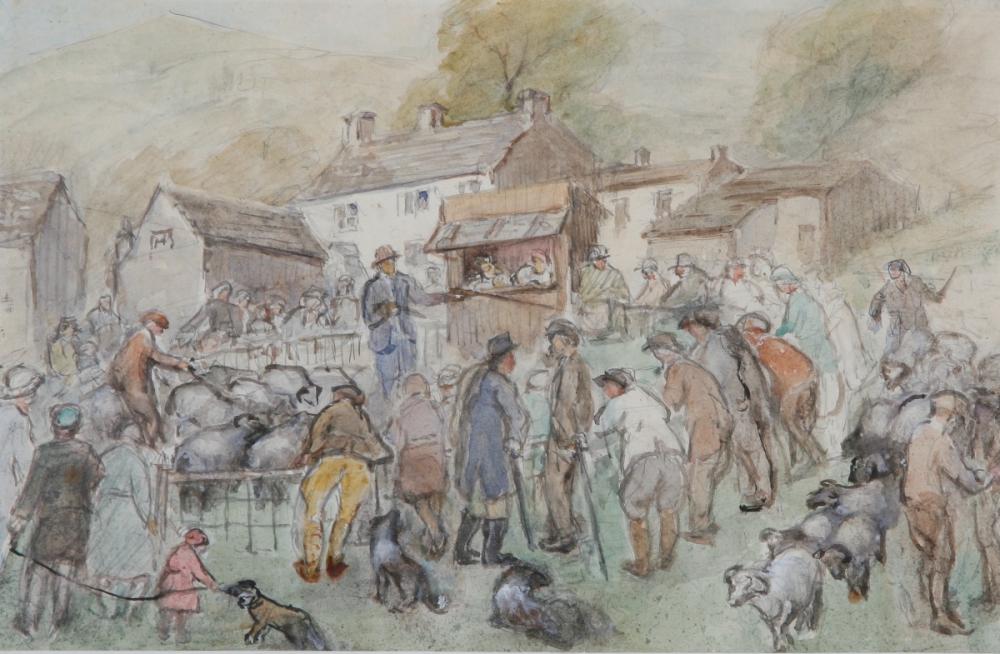
Malham Sheep Fair - Constance Pearson
As instinctively receptive as the Dales farming community to nuances of climate and rapid transition, Katharine Holmes is a conduit, a lightning rod for the revelation of the momentary glimpse. Her acute sensitivity to tonal change should come as no surprise to the informed viewer: born and raised in Malhamdale, she has never left the valley in protracted earnest, and is as consistently drawn to the same Dale locations – especially the gaunt cliff-face of Malham Cove – as a seduced obsessive.
The narcotic transcends mere attraction and the artist, by her own admission, tries to return as much as she derives from the landscape, in the nature of aesthetic recompense. The idea of ‘giving back’ is one unacknowledged trope amongst several at a recent exhibition of Katharine Holmes’ work at the Folly in Settle. Another, by association, is the inclusion of some of the work of her mother, Philippa Holmes (1921-1999) and grandmother, Constance Pearson (1886-1970), both of whom lived in Malhamdale. Interspersed amongst the, often, larger canvasses of Katharine, the pictures are illuminations, delineating a sense of familial continuity alongside stark thematic differences. Where Katharine Holmes is a dramatic re-imaginer of the Yorkshire Dales in all of its polytonal diversity, Constance Pearson inclines towards the inhabitants of this landscape – its farmers and markets, labourers and workmen. Animating the figures within her purview with a real sense of kinetic purpose – the watercolour ‘Malham Sheep Fair’ breathes life into an otherwise static tableau – Constance Pearson infuses her work with a bounty of suggestion, not least the ‘noises-off’ of conversation, the sheepdog’s bark and the generalised mayhem of a thriving meeting place, construed in the silence of a home studio.
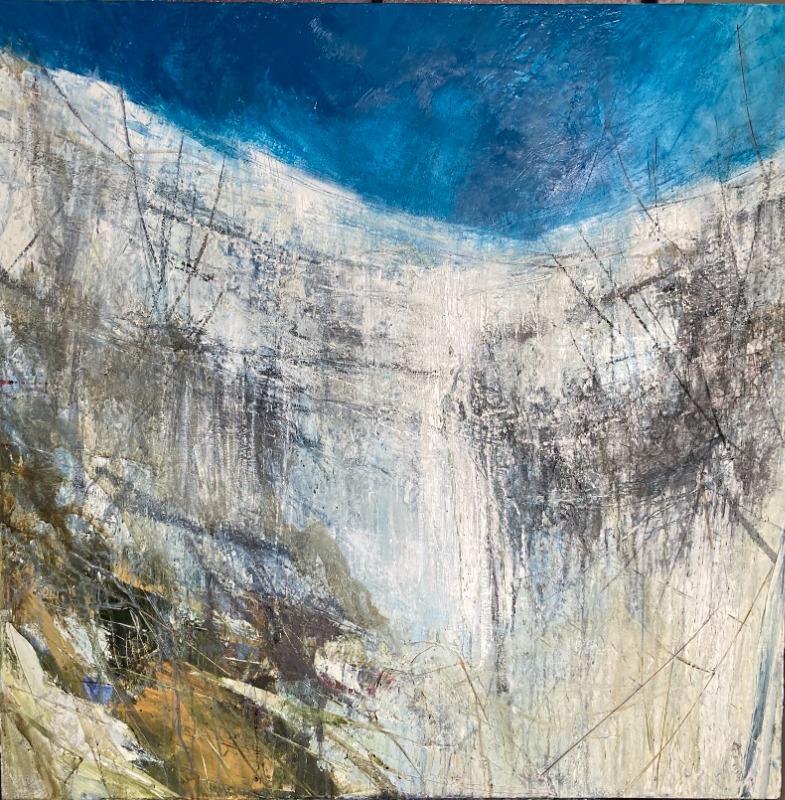
Malham Cove - Katharine Holmes
And where subject-matter occasionally converges, Katharine wisely juxtaposes her own work with her grandmother’s, to yield telling differences in approach: Constance’s darkly brooding representation of ‘Malham Cove’ contrasts wildly with her granddaughter’s steroidally-scaled impressionism. Invariably conceived ‘face-on’, Katharine’s aeonic sense of narrative informs her Cove paintings with a luminous depth, whose boundaries are blurred like Turner’s, dissipating definition and rendering horizons of rock and sky transcendently indistinct. If Katharine Holmes were to ‘people’ her canvasses, as Turner sometimes did, the figures would be subsumed by the sheer scale of the cliffs and valleys, as confounded by perspective as visitors to the mountains of the Lake District. The arch blues of the sky in ‘Malham Cove’, throw the vertiginous whites and greys of the cliff into massy relief, with scraps of sketchy vegetation to underwrite the scale of the piece. And if the combined effect of ‘Limestone and Rain’, a work of oil on canvas, again approaches the vague opacity of Turner, then it is authentic to a way of seeing.
The process seems as persuasive as it is befitting of a conjunction of elements: the propensity for occlusion on violently changeable days lends Katharine Holmes’ work a species of authenticity – that which thrives in a maelstrom of atmospheric suggestion. ‘Limestone Waterfall in Spate’ charges the cataract with immense muscularity, as if to invest the scene with the kind of anthropomorphic power that so exercised the purveyors of the Romantic Sublime. That sense of suggestion finds an outlet in one of the exhibition’s finest canvasses – ‘Limestone Waterfall’ – whose subtle polychromatic blending achieves a pitch-perfect, and somehow lucent, marbling effect.
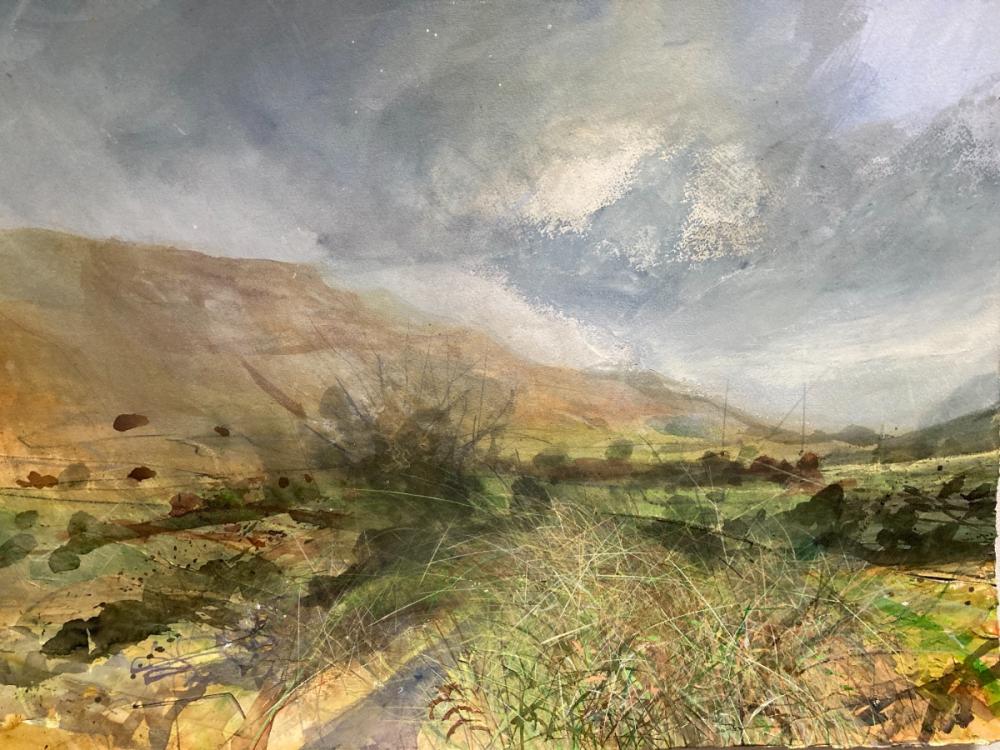
Late Summer Coming Home from the Moor - Katharine Holmes
A fitting tribute to a gifted matriarchal line, Katharine Holmes’ exhibition is a paean to art, to the celebration of a valley and its people, and to continuity in a time of change.
Also by Steve Whitaker...
Poem Of The Week: Dicks By Eoghan WallsPoem Of The Week: Marky By Ian DuhigPoem Of The Week: Heredity By Thomas Hardy (1840-1928)Poem Of The Week: The Old Pantry By Peter Scupham (1933-2022)Review: There's No 'F' In Wonderful By Bill BroadyThe shortened address for this article is: newspub.uk/01xwc
Search Results