



search
date/time

Thu, 10:00PM
scattered clouds
13.3°C
WSW 11mph
scattered clouds
13.3°C
WSW 11mph
 | Sunrise | 5:40AM |
| Sunset | 6:17PM |  |

Steve Whitaker
Features Writer
@stevewhitaker1.bsky.social
P.ublished 25th March 2026
arts
Blood, Bile, Pus: Bodily Fluids By Liam Hughes
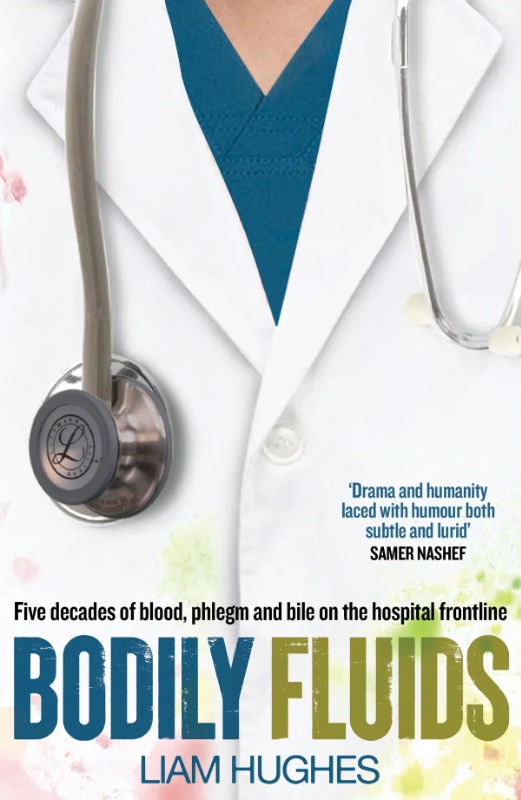
The verisimilitude extends to Hughes’ style of exposition: unconvoluted, direct and very funny, but with a polemical overlay that bespeaks a real concern for the future of the service, and a sincere commitment for patient wellbeing. The final chapters of Bodily Fluids - an unashamed titular tilt at the book’s market potential – are largely given over to these concerns and it would be a shortsighted critic who’d argue with Hughes’ insightful prescriptions. Not least in the arena of training: railing against a system that privileges academic and theoretical prowess over hands-on processes of treatment, and encourages an alarming diversity of specialisms that undermine continuity of care, Hughes points to one of many unintended consequences:
‘Unfortunately this encouragement to gain practical skills has been phased out, sacrificed on the altar of safety. As a result, hospitals are full of doctors, including consultants, who cannot perform even basic resuscitative procedures, and cardiologists who can’t treat life-threatening emergencies.’
The rest, as we know, are legion: dilution of treatment, further separation of medical staff from patients, lack of a coherent plan. Hughes’ distinct and unequivocal style overlays experiential anecdote with explosive moral and ethical indignation. Citing the case of a family of Jehova’s Witnesses who refuse to countenance a blood transfusion for a daughter whose prognosis is otherwise bleak, Hughes excises the danger by taking the decision out of the parents’ hands, to find, to his surprise, that their relief is palpable as the daughter is saved. Mealy-mouthed hypocrisy is rarely lost on the cardiologist whose medical knowledge and according sense of urgency have little truck with the absurd proscriptions of religious orthodoxy:
‘Even now this astounds me, and I can only agree with the late Christopher Hitchens that religion can cause normally caring people to behave in a profoundly inhumane way.’
Nor has he any sympathy for the making of religious exemptions amongst staff. Following a scene in which a medical student introduces a bible into the treatment of a terminal patient, Hughes maintains the not unreasonable view that the rubric of faith and observance has no place in medicine. And if we detect a maverick in the bluff and no-nonsense literary exterior then we may equally be certain that the thorough and committed professional has been shaped over many decades of vocational experience. For Hughes manifestly cares about his patients, as his lengthy reflection on the phenomenon of the ‘Brompton Cocktail’ – an amalgam of heavy-duty painkillers calculated to ease the final hours or days of the dying – illustrates. That the cocktail might also end suffering is a moot point amongst practitioners: Hughes’ desperately moving story of the terminal decline of one patient is an exercise in compassion that would make, in a less proscriptive world, a persuasive template for the NHS’ palliative care mandate. John’s final hours, presided over by a group of attentive and deeply caring medical staff, conclude with a dignity that only the administering of an effective overdose of painkillers, planned earlier and with the complicity of the patient, might vouchsafe.
But it is the viscera and the effluent, the evacuation, the ejaculation and the copious leak, that form the book’s teeming anecdotal narrative, as if the solution to almost all medical problems were – are – to be located in the blood and exhaust mechanisms, and diagnosed by use of a drip, an enema or a catheter. Hughes’ brilliant and entertaining journey through the human body, its occasional unpredictable dramas, its capacity to confound and reward, is genuinely illuminating. That he is profoundly self-aware, governed by science and instinct, and entirely honest, helps to confirm the truth of what a consultant epidemiologist once told me: that diagnosis, though informed by skill, knowledge and precedent, is often a matter of guesswork.
More information here.
Also by Steve Whitaker...
Poem Of The Week: Soirée By Peter Reading (1946-2011)Children's Poem Of The Week: Catamaran Smile By Carmella de KeyserFrom Ukraine To Kilimanjaro: Diana's JourneyPoem Of The Week: Hilltop By Ruth SharmanPoem Of The Week: Pretending Not To Sleep By Ian Hamilton (1938-2001)The shortened address for this article is: newspub.uk/01yvh
Search Results