



search
date/time

Wed, 1:00AM
overcast clouds
16.6°C
WSW 7mph
overcast clouds
16.6°C
WSW 7mph
 | Sunrise | 5:12AM |
| Sunset | 6:56PM |  |
P.ublished 28th August 2026
business
Yorkshire Business Confidence Falls In August Amid Weaker Economic Optimism
.png)
Companies in Yorkshire reported lower confidence in their own trading outlook month-on-month, down eight points at 52%. When taken alongside their optimism in the economy, down 22 points to 40%, this gives a headline confidence reading of 46% (vs. 61% in July 2026).
Yorkshire firms’ confidence in the economy was driven by strong customer demand (60%) and improving interest rates (45%), while confidence in their own trading outlook was driven by strong market demand (56%) and strengthening supply chain conditions (44%).
A net balance of 40% of businesses in the region also expect to increase staff levels over the next year, down 19 points on last month.
Business confidence in the Yorkshire still sits above the 12-month average of 44%, with its highest figure of 62% in March 2026.
Looking ahead to the next six months, Yorkshire businesses identified their top target areas for growth as investing in their team (46%), entering new markets (44%), and introducing new technology, such as AI or automation (34%).
The Business Barometer, which surveys 1,200 businesses monthly and which has been running since 2002, provides early signals about UK economic trends both regionally and nationwide.
Despite a dip in business confidence, it’s encouraging to see businesses in Yorkshire still backing themselves to grow.
Strong consumer demand, improving financial conditions and better supply chain conditions are providing reasons for optimism.
Four in ten businesses expect to grow their teams over the next year, and many are already planning to enter new markets and introduce new technology. We'll continue to support Yorkshire businesses as they invest, adapt and plan for the future.
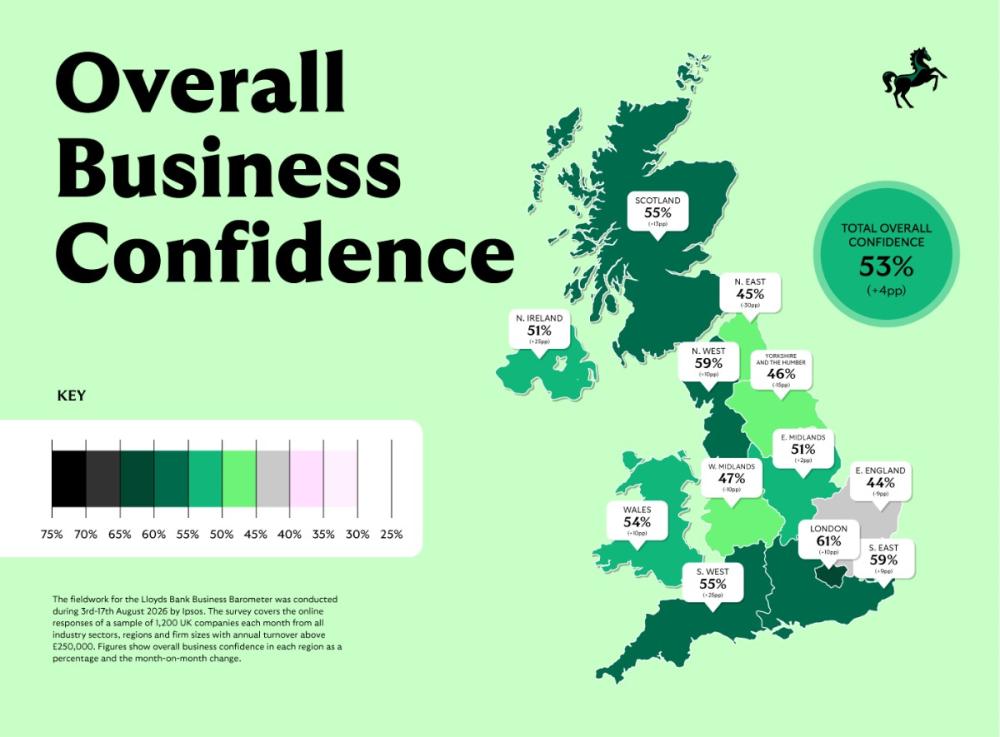
Overall, UK business confidence increased four points in August to 53%, the highest reading since the start of the Middle East conflict in March (55%) and above the 12-month average of 47%.
This was driven by a second month-on-month increase in economic optimism, up 18 points since June.
Optimism in the wider economy rose seven points to 49%, compared to a 12-month average of 37%. Of those surveyed, 64% said they were optimistic (up five points from July) in the wider economy, while those who felt pessimistic decreased by two points to 15%. The main factors cited by firms who felt more positive included stronger customer demand and improving financial conditions.
Businesses’ own trading outlook improved two points to a three-month high of 58% in August, compared to a 12-month average of 56%. Sixty-six percent of firms (up one point from July) expect an increase in output over the year ahead, while those expecting a decrease in activity reduced by one point to 8%. Among firms expecting stronger activity, the main factors were stronger customer demand, increased investment in capacity or tech and improved supply chain conditions.
It's encouraging to see business confidence rise for the second month in a row, reaching its highest level since March.
While international firms remain more confident, it’s good to see domestic companies register a strong month-on-month increase.
Overall, businesses are reporting stronger customer demand, greater optimism about the wider economy and growing confidence in their own trading outlook, all of which will be helping to support investment and growth plans.
While businesses continue to operate in a challenging environment, easing cost pressures and fewer firms expecting to raise prices in the coming year, should allow them to focus less on managing headwinds and more on pursuing growth.
The shortened address for this article is: newspub.uk/020rc
Search Results