



search
date/time

Fri, 10:00PM
light rain
15.2°C
SW 14mph
light rain
15.2°C
SW 14mph
 | Sunrise | 5:42AM |
| Sunset | 6:14PM |  |

Steve Whitaker
Features Writer
@stevewhitaker1.bsky.social
P.ublished 18th September 2026
arts
Understanding The Stone: The Green Parcel By John Challis
John Challis’ poems carry a similar tintinnabular weight: a shadow of history, of antecedence, the past, in his new collection, becomes an organic part of the poems themselves and sometimes, with self-conscious irony, of the process involved in their recreation. A celebration of echoes of the ordinary – of the artisans, the grafters, the drudges whose efforts make up some of the surviving architecture of all of our histories – Challis’ ‘footprints’ (they are subtly insinuated in a narrative of continuum, not stasis) are memento mori, outlines in the snow. And it is hard, in the sense of giving voice to the long-since voiceless, not to reconsider Tony Harrison’s Victorian paper-hanger, whose single extant line was his own memento mori, discovered, as it was, in Grasmere Church, the final resting place, if we needed reminding, of another, more illustrious writer:
‘our heads will be happen cold when this is found’
The simple aphorism, for Harrison, restores an unequal balance, gives authorial tenure, for once, to the muffled dead. And so, in The Green Parcel, Challis lends gravitas to the invisible hands that work the interstices between his narrator(s) lines; the bats fidgeting ‘in their homes within the walls’ in ‘A Way of Knowing’ reinforce the titular sense of inference, of picking something up in a timeline whose markers ring like the efforts of a mason’s chisel on a church’s statuary, transcending the very faith towards which his tool inclines. Here, four visionary stanzas inhale the wind, transfigure the crenellations of history into an organic sense of expectancy: ‘Stone is turning into wing / behind the stucco togas. I sit here. I listen.’
In ‘Closing Night’, a sonnet that moves from reflection to denouement in the persuasive diptych of an octet and a sestet, Challis gives metaphysical ‘body’ to his precocious antennae, his decoding of presence in the historical aether. The narrator figure seared in the updraught of a catastrophic fire which began in a chimney at Seaton Delaval Hall in 1822 and melted glass in its intensity, may be the spark that galvanises a new way of seeing, yielding metaphors of a theatrical curtain call and the rising of an audience of the buried dead, in the binary paradox of an inferno.
A not uncommon symbol in this poet’s work, fire reappears by backlit suggestion in the affecting, and sparsely rendered ‘Fired City’, whose prophetic eloquence reconfigures an artist’s sketch into a shape-shifting tableau of illuminated destruction as resonant as MacNeice’s ‘Brother Fire’. Here, the Thames is lit…
‘into an airstrip.
Squint and see the lines
he made, a barely
standing row of houses
bend and grow
becoming mothers
passing debris down a chain’.
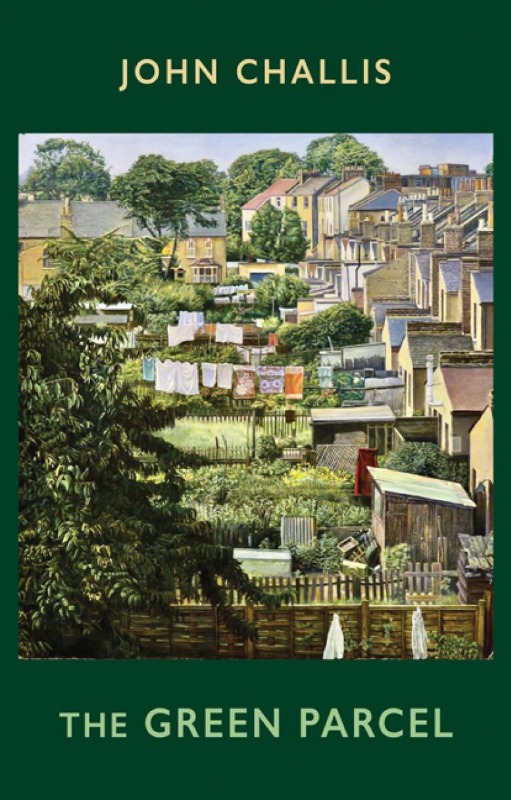
The musculature of the verbs prepares the ground for a psycho-geographical transition between paint and bomb damage, between the act of creation and wanton destruction, as ‘slabs of masonry’ collapse on the citizens of London after an air-raid in 1942. It is these last, these ordinary folk, their labours and efforts silenced by time, who make of the book’s title, a metonym for a sense of temporal continuity: the ‘green parcel’ of quotidian gardens, beautifully realised in the cover painting, by Paul T. Bartlett, burgeon topographically outwards like Larkin’s postcodes, to celebrate memory and human productivity.
And everywhere the invisible ‘I’ or ‘We’, the voices assembling in time’s darkness, like the ghosts of urban sojourners dreaming of an impossible bucolicism: the title poem is a finely woven journey through a pastoral hinterland, delivered in the steadily rhythmical tones of a saunter, where the halcyon ideal portrayed on the sides of buses is undermined by a lack of specificity, of authenticity in the detail. It is fitting that the final quatrain should conclude in a cloud of ambivalence:
‘Another world. But here she was in what
compared to Plaistow was the wild,
where her son could learn the living way
under bright districts. Or so the story goes.’ (‘The Green Parcel’)
The sense of evanescence is deafening in so many of Challis’ excursions. The wraiths of children who are foregrounded yet retreat from view, or are subsumed into the fabric of the woodland that once echoed with their voices, are, by turns, sotto voce and ‘unageing’, witnessed by a narrator, and poet, who is gifted with a kind of prescience of complicity:
‘Pity us, our long stare.
Our world is a window.’ (‘Youth’)
The voices of indifferent youth, the scrawlers and carvers who inscribe their own fleeting legend in the stonework of an old tomb, may be heard in ‘Mausoleum’, their ‘single extant line(s)’ rendered with capricious disregard, yet making of their defacements a sort of statement that is no less intrinsically meaningful than the poet’s own, neatly tetrametrical, ‘homage’: ‘Today, / after the storm, I came and found / this poem sleeping in the crypt.’
There is an integrity to Challis’ existential uncertainty, a feeling that something exists just beyond our ken – for example, in the estuarial dark illuminated only by the lighterman as he proceeds at a cortege’s pace towards the sea (‘North Shields Nocturne’), or in the strange Audenesque phenomenon of an Icarean figure falling out of the blue into a field of buttercups (‘Trip Report’). Both are signifiers, perhaps portents, like the city snow in ‘London’s Edge’ and the oddly persuasive, isolate metaphor for the frenetic unravelling of time: ‘like debris from a city burning overhead’, whose flames are those of the Blitz (‘Old City’).
Challis’ inner eye roves over markers as disparate as a field of pylons, stately piles and cathedrals, to distant geographies as far removed from the poet’s birthplace of London as a power station in California and the Grand Canyon. He is not delimited by the vagaries of distance: this poet of the protean imagination finds opportunities for aesthetic apprehension in every field of enquiry, in skilled confections of time and place, and sometimes in philosophical repose, such as in ‘On the South Rim of the Grand Canyon’, whose deepening river passage becomes a metaphor for the iron-slow process of human revelation, of beginning to understand the nature and disposition of existence. The poems sometimes coalesce disjunctures of geography and space into serendipitous concord: the lyrical continuity of ‘American Routine’ detects a profound, and instinctive, suggestion of the ‘Old Country’ in the furniture of the American present by a species of transference. Seamlessly unfolding, the poem’s gentle rhythms encourage a daydream of reinvented landscapes, of an accommodation between what we see, and what experience and historical memory confer: ‘Although I see a part of home / in every word repurposed for the West’.
Prometheus infolded into the fire from which he first emerged makes a persuasive figure for the collapsing of a dream in ‘A Field Out West After the Fourth of July’, in a phenomenon, perhaps a fire festival, observed in the kind of silence that existential contemplation confers. Applying the same gift for focus to death and decline’s obverse, Challis’ poems dealing with his relationship with fatherhood are among the finest of a universally compelling collection. Measured, perceptive, overlain with a patina of humility, the poet’s love for his daughter is manifest both in the innocent awe of his expression, and the invisible bond that seems to exclude all extraneous consideration from the uniqueness of the connection. Intensely charged, reminiscent of Coleridge in ‘Frost at Midnight’, the oxymoronic and fevered ‘Wreath’, and the ironic ‘Kindling’, underwrite the needfulness of love in affecting realisations of paternal care.
But most, in ‘Veil’, Challis’ returns to the beginning, to explore the liminal space between the womb and the bright blue world of birth. Beautifully drawn, the riverine, amniotically-suspended, tercets precisely measure the moment at which the veil is removed and the waters flow in a serendipitous simulacrum of a rescue:
‘I dream I wade
through blue light
to dredge her
from a riverbed,
the girl held
above my head,
the tide of light
at my waist,
pulling me
to the other side.’
The Green Parcel is published by Bloodaxe Books (2026)
www.bloodaxebooks.com
Also by Steve Whitaker...
Poem Of The Week: Soirée By Peter Reading (1946-2011)Children's Poem Of The Week: Catamaran Smile By Carmella de KeyserFrom Ukraine To Kilimanjaro: Diana's JourneyPoem Of The Week: Hilltop By Ruth SharmanPoem Of The Week: Pretending Not To Sleep By Ian Hamilton (1938-2001)The shortened address for this article is: newspub.uk/020yl
Search Results