



search
date/time

Sat, 4:00AM
overcast clouds
16.2°C
SW 13mph
overcast clouds
16.2°C
SW 13mph
 | Sunrise | 5:44AM |
| Sunset | 6:12PM |  |

Steve Whitaker
Features Writer
@stevewhitaker1.bsky.social
P.ublished 24th April 2025
arts
The Englishwoman And The Norwegian Holocaust

Myrtle Wright
In his extraordinary new book, Norway's War, renowned historian Robert Ferguson retells the narrative of the Nazi occupation for a modern audience, centering his study on the German attempt to enforce a Nazi-sympathetic administration on the Norwegian people, in a kind of Pax Norvegia and under the tainted tenure of the infamous Vidkun Quisling.
The will of the people to resist the occupation, not least on behalf of the indigenous Jewish population, is hugely foregrounded in Ferguson's study. One chapter in the book, 'The Norwegian Holocaust', details a little-known 37-year-old Cambridge woman called Myrtle Wright, who travelled to Norway in April, 1940 on her way to Copenhagen, but was delayed by bad weather. Three days later the Nazis invaded Norway, and despite many legal attempts to leave, she was trapped in the country, eventually becoming a part of the underground resistance, largely run by women, including 48-year-old mother-of-two, Sigrid Helliesen Lund. Together, they received coded messages, warned their Jewish neighbours and helped Jewish women and children to safety. Wright eventually managed to escape to Sweden on 10th February 1944 in the middle of the night, using the same snowy forest route through which they assisted many Jews, and was later awarded King Haakon VII’s Freedom Cross for her outstanding services to the country.
'Of other groups involved in the rescue of Norwegian Jews during the Norwegian holocaust of the winter of 1942 there was one in which women played a particularly active part. Among the group’s leaders was Sigrid Helliesen Lund, a mother of two who was forty-eight years old when the war came to Norway. She lived in a villa on Tuengenallé, in the Vindern district of Oslo, and among her closest associates and helpers in the rescue operation was a thirty-seven-year-old Englishwoman from Cambridge named Myrtle Wright.
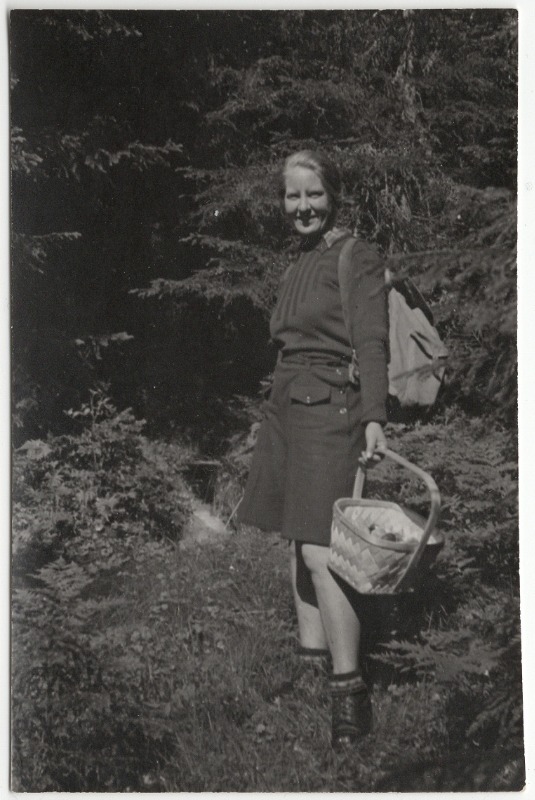
Myrtle Wright at Harestua, 1942
On the night of October 25 1942 an anonymous caller telephoned the house on Tuengen alle and delivered a simple but enigmatic message: ‘There’s a big arrangement on tonight. But we’re only taking the big packages’. Sigrid and Myrtle tried to puzzle out what the message meant. Selskap was a code that warned of trouble; but what could ‘big packages’ mean? Finally, and almost simultaneously, the two women had it: the caller, almost certainly a patriotic policeman, was informing them that the arrest of the Jews was imminent, but that only Jewish men - ‘the big packages’ - were to be taken. Phone calls were monitored, hence the need for code. Sigrid at once left and spent the night going round her Jewish acquaintances, spreading the news and urging people to go into hiding instantly. Myrtle stayed at the house on Tuengen alle to receive those people for whom no immediate hiding places could be found.
Wright’s diary entry for November 23 – her birthday – describes how, in the midst of those terrible times, she and Sigrid tried hard to maintain a sense of normality in their daily lives. The two women, with the family dog Tasso, took the tram up to Frognerseter and went for a four-hour walk in Nordmarka. At Tyrvannstua the ski-run was not yet snow-covered, but the lake was frozen, and they watched the young boys skating there while sipping ersatz coffee made of sugar beet. Two days later, on November 25,the doorbell rang at Tuengenallé and Sigrid opened the door to a stranger who delivered another enigmatic warnng: ‘There’s a big arrangement tonight. We’re taking the small packages this time’ he said, then turned and walked back into the street.
Having cracked the code on the earlier occasion the women knew that Helliesen Lund would once again be spending most of the night ahead out ringing on doorbells and trying to warn as many Jewish families as possible to make ready to leave instantly, as well as telephoning around to organise safe houses for those who heeded the warning.
Myrtle Wright again remains at the house in Vindern to receive those sent by Sigrid to wait in hiding while safe houses were found for them. Lund later described to Wright how her first call had been to the wife and three children of the rabbi of Oslo, Isak Julius Samuel, at Meltzers gate 3. Rabbi Samuel himself had been arrested earlier and taken to the prison camp at Grini to await transportation. Lund was able to take the two older children to safe homes without incident but was almost caught as she was moving third child, three-year-old Amos, whom she was taking to a separate safe house, on Colbjørnsons gate.
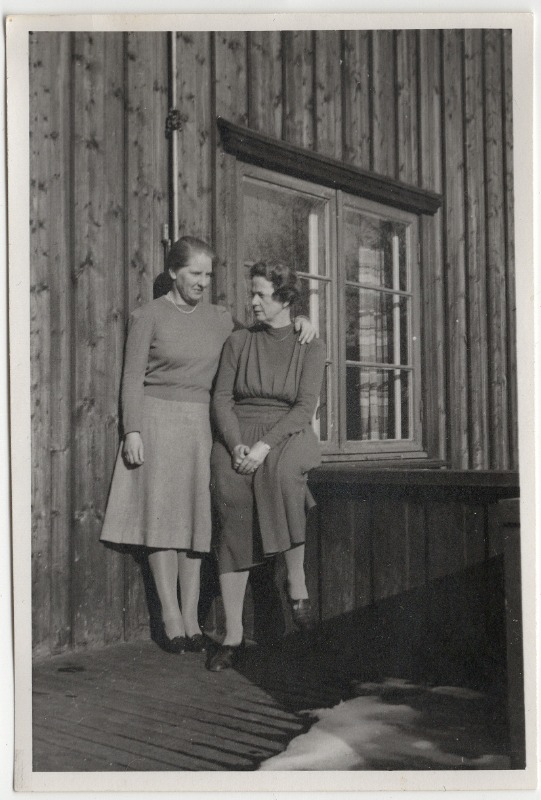
Myrtle Wright and Sigrid Helliesen Lund
Some of these were children she had personally brought to the apparent safety of Norway three years earlier, as part of a group of thirty-seven, in the fatal lull between the German entry into Czechoslovakia in March 1939 and the invasion of Norway on April 9 1940. Most had been housed with foster parents outside Oslo but fourteen remained at the Home. On arrival she found her friend Nic Waal had the same thought and driven to Holbergs gate. Between them the two women and the children’s ‘foster-mother’, Nina Hasvold, managed to spirit the children to safety just hours before the operation to collect the ‘small packages’ got under way. Nic Waal had to make three trips, with the children hiding under rugs and cushions on the back seat of the car. With the air-raid sirens still wailing at frequent intervals she was stopped in her first trip by soldiers at a checkpoint on Hegdehaugsveien. She bluffed her way past them, angrily pointing to the sticker on her windscreen that showed she was a doctor out on business and fully entitled to be on the streets. In Alltidunderveis (Always on the move), her memoir of the times, Helliesen Lund writes that most of those who agreed to hide Jewish families in their homes, always at huge personal risk, were ‘older women living alone’. Pressure on the ‘export businesses’ as the transports into Sweden were known, was intense at the time and those in hiding had to wait weeks and often months before their turn came. There was the added burden of extra mouths to feed in already hard times, and of doing so without arousing the suspicions of an unsympathetic neighbour who could be moved to report them to the authorities.
On January 27, 1944, Wright was woken at 6.30 a.m. by two Gestapo members who had come to arrest Sigrid’s husband, Diderich Lund. He had already been warned and fled. The Gestapo left, first rebuking the women for the portrait of King Haakon VII that hung on the living room wall –pictures of the Norwegian royal family were forbidden. The visit served as a warning to Lund and Wright that Tuengen alle was no longer a safe place to live. They moved to a secret address, and on February 10 were among a party of refugees who trudged in silence through the moonlit and snow-dense forests before crossing the border into safety of neutral Sweden. Following the end of the war and the occupation, in 1946 the Norwegian government awarded Myrtle Wright its King Haakon VII’s Freedom Cross for her outstanding services to the country. She remained a close friend of the Lund family for the reminder of her life and returned to Norway many times.'
Available now at bookstores and online, more information here.
Also by Steve Whitaker...
Poem Of The Week: Among The Talk And The Laughter By Norman MacCaig (1910-1996)Understanding The Stone: The Green Parcel By John ChallisPoem Of The Week: Soirée By Peter Reading (1946-2011)Children's Poem Of The Week: Catamaran Smile By Carmella de KeyserFrom Ukraine To Kilimanjaro: Diana's JourneyThe shortened address for this article is: newspub.uk/01uli
Search Results