



search
date/time

Sat, 1:00PM
light rain
8.4°C
SSE 17mph
light rain
8.4°C
SSE 17mph
 | Sunrise | 6:48AM |
| Sunset | 4:48PM |  |
P.ublished 18th July 2023
arts
Strong Contradictory Feelings : My Hollywood And Other Poems By Boris Dralyuk ; The Feeling Sonnets By Eugene Ostashevsky

‘their writing is almost always fearlessly self-interrogative, searingly honest about the contradictory feelings inspired by life in exile’.
The hotel housed drunken stars such as F. Scott Fitzgerald, Humphrey Bogart and Marlene Dietrich
What’s interesting is that, despite recognising that he hadn’t translated as many living writers as he had dead ones, he still chooses to write of them in the present tense (‘their writing is…’). Maybe it’s because it’s a feeling he is experiencing in his own present. Through examining the influence of Russian and Ukrainian people and culture in Hollywood, USA, My Hollywood is, among many other things, an exploration of the contradictory feelings inspired by a life abroad.Drayluk has a compendium of translations to his name. This is his first collection of poems. Until recently, he was the editor of the Los Angeles Review of Books. In My Hollywood, he writes among other forms, mostly, Onegin sonnets. He introduces us to people you will both have likely and unlikely heard of making their life in Hollywood. ‘The Garden of Allah’, for example, refers to the hotel owned and opened by Alla Nazimova in West Hollywood (Nazimova starred in an adaptation of Robert Hitchen’s novel, Bella Donna. Notably, the name of the hotel shares its name with a novel by Hitchens about a wealthy English woman marrying a half-Russian man who spent most of his life living in silence in a monastery). The hotel housed drunken stars such as F. Scott Fitzgerald, Humphrey Bogart and Marlene Dietrich. The poem goes:
‘And now I watch another era fade,
Cyrillic letters scraped from the shuttered storefronts,
tar-crusted bread, stale, fish, stiff marmalade
sit sulking on the shelves
unchosen orphans
in what we were once the bustling little shops
of Russian Hollywood [...]’
There's plenty of contradiction here. The tone hits you first: nostalgic, almost sentimental, largely imparted by the rhyme scheme and a blend of short and long vowel sounds. Initially, history is presented as a palimpsest, and scraping the surface only reveals the influence of the past. Yet, if we look at the lines - the sense of an era fading, the cyrillic letters needing to be ‘scraped’ off along with that verb, ‘sulking’ - Dralyuk invokes the image of someone or something not wanting to let go. The poem is not jolly, nor is it a celebration. By the time those ‘unchosen orphans’ come around, the poem is in a different space completely. In the final lines, as we read of Nazimova’s death, we’re reading an elegy and the tone is mournful.
Being the deeply conflicted and troubled species that we are, I wouldn’t bet against all those meanings being encased entirely
In another interview for the European Literature Network, Dralyuk has stated how he considers Odessa his home ‘come what may, although decades went by without my setting foot in it’ (Odessa, a large port city in Ukraine where people speak Russian and Ukrainian, has been of strategic importance throughout history in Ukrainian and Russian relations). In the same interview, he also said ‘even if I do leave Los Angeles, I’ll never truly leave’. Dralyuk clearly has an idea of place and what it means to retain an idea of a place (think of that possessive ‘my’ in the title of his collection). When we read a translation of Vladimir Korvin-Piotrovsky (1891-1966), a poet born in Kyiv who, after fighting in World War Two and for the French resistance, spent the last 14 years of his life in Los Angeles, Russia is mentioned. But, first, we’re introduced to a ‘sandy wasteland - lifeless, bare - in a Colorado landscape…that lures…with unseen depths of blue.’ Enchanting perhaps, but also anonymous and vacant. Indeed, the title itself - ‘We’re Going Fishing’ - sounds like that established parlance of absence, ‘gone fishing’. Dralyuk then writes:‘O Russia - you’re so far away now
that I can never part with you.’
Dralyuk might be inspired by the apparent distance Korvin-Piotrvsky depicts in between him and Russia, but it’s not difficult to see lines like this through the lens of contemporary events in Russia and Ukraine. In the context of Dralyuk’s comments, ‘part’ could be a verb or a noun. Korvin-Piotrovsky could be directly echoing what Dralyuk said about Odessa and Los Angeles and that he, Dralyuk, is addressing ‘parts’ of him represented by place. Or part could be a verb, and Dralyuk is trying to distance himself further from Russia. Being the deeply conflicted and troubled species that we are, I wouldn’t bet against all those meanings being encased entirely.
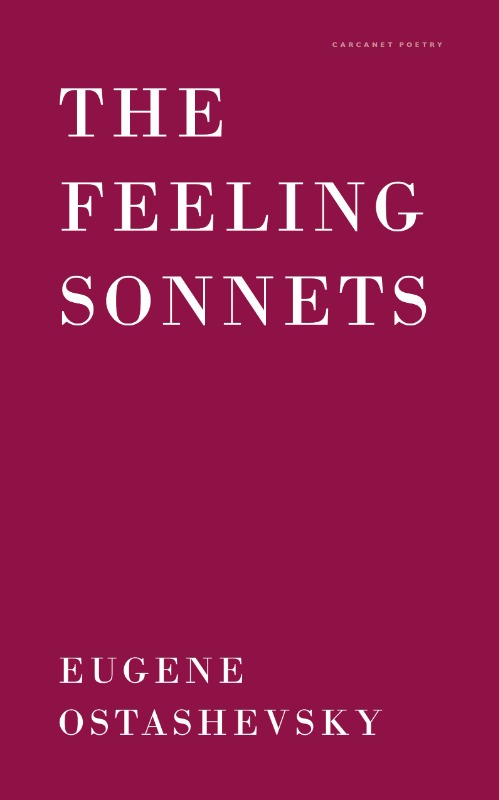
The sonnet form is utilised differently by Ostashevsky. The basis of Ostashevsky’s verse is an irregular rhyming scheme, instead playing with internal rhymes and puns. Where Dralyuk and Ostashevsky are similar is that they are writing about ‘contradictory feelings’. In fact, Ostashevsky is searingly honest about his contradictory feelings in the opening lines of his collection: ‘It’s with profound ambivalence’, he writes in the opening lines, ‘that we inform you of our feelings.’ Does ambivalence mean ‘mixed feelings’? Maybe. Either way, Ostashevsky’s poems read like a way of somebody trying to articulate a deeper and darker sense of powerful, profound maybe, emotions.
At first, his sonnets seem to display characteristic wit while being abstract and allusive in their subject matter:
‘As for number, it is so named because it is numb.
Between numb and numbest, there it is.
Nonetheless it too is a limit.’
Certainly, Ostashevsky is droll and deadpan. If we consider, however, the idea of ambivalence not as ‘mixed feelings’, but something closer to the psychoanalytic idea of embodying contradictory feelings of love and hate, there is an image of somebody working through these feelings and all that might come with doing so. From numbness, we see Ostashevsky conjure images of ‘grasping’ and ‘reaching’:
‘Now there is feeling without feeling.
Take your hand. Take your hand away.
Why is a hand like a portrait. A hand is a face.
Portraits let us feel hands we must not feel. Or is it cannot.
What are we feeling when we are feeling without feeling.’
The viewpoint shifts from an address to an unnamed person to the reader. So when the poem finishes with the line, ‘Is war at hand. Will it take our hands away./ On the other hand. Do we have hands for the taking’, it suggests there is threat in grasping. Grasping for what? An answer? A lack of question marks would suggest Ostashevsky is writing in an environment where questions cannot be asked, and that probing or asking questions is dangerous.
As the collection continues, Ostashevsky more explicitly evokes images and feelings of misery, and it’s as if we are witnessing somebody uncovering, or discovering that which might have been hidden from them and the title of the section (the title of the section, ‘Die Schreibblockade’, ‘Writer’s Block’, suggests there’s an inhibitory mechanism to the novel). ‘I have returned to the city of my dead,’ he writes in the opening of Sonnet 41. Now beside his puns and wit, starvation and death litter the poems as his tone becomes increasingly mournful.
Indeed, some psychoanalysts might say the act of mourning in these poems is inspired by the working through of ambivalence. But when we see an endnote that says Ostashevsky wrote these poems ‘two years before the memory of the Blockade was befouled by the Russian siege of Mariupol and other Ukrainian cities’, we’ve reason to believe that mourning is inspired by the continuing spectre cast by the events of that dreadful invasion and war.
My Hollywood and Other Poems by Boris Dralyuk is published by Paul Dry Books
The Feeling Sonnets by Eugene Ostashevsky is published by Carcanet
This review was conceived and written by Liam Bishop
The Feeling Sonnets by Eugene Ostashevsky is published by Carcanet
This review was conceived and written by Liam Bishop
The shortened address for this article is: newspub.uk/01lgm