



search
date/time

Tue, 4:00PM
few clouds
18.0°C
W 19mph
few clouds
18.0°C
W 19mph
 | Sunrise | 5:37AM |
| Sunset | 6:22PM |  |

Steve Whitaker
Features Writer
@stevewhitaker1.bsky.social
P.ublished 16th July 2023
arts
Poem Of The Week : On His Dead Wife By John Milton (1606-1674)
On His Dead Wife
Methought I saw my late espousèd saint
Brought to me like Alcestis from the grave,
Whom Jove’s great son to her glad husband gave,
Rescued from death by force, though pale and faint.
Mine, as whom washed from spot of childbed taint,
Purification in the old Law did save,
And such, as yet once more I trust to have
Full sight of her in Heaven without restraint,
Came vested all in white, pure as her mind:
Her face was veiled, yet to my fancied sight,
Love, sweetness, goodness, in her person shined
So clear as in no face with more delight.
But O as to embrace me she inclined
I waked, she fled, and day brought back my night.
Methought I saw my late espousèd saint
Brought to me like Alcestis from the grave,
Whom Jove’s great son to her glad husband gave,
Rescued from death by force, though pale and faint.
Mine, as whom washed from spot of childbed taint,
Purification in the old Law did save,
And such, as yet once more I trust to have
Full sight of her in Heaven without restraint,
Came vested all in white, pure as her mind:
Her face was veiled, yet to my fancied sight,
Love, sweetness, goodness, in her person shined
So clear as in no face with more delight.
But O as to embrace me she inclined
I waked, she fled, and day brought back my night.
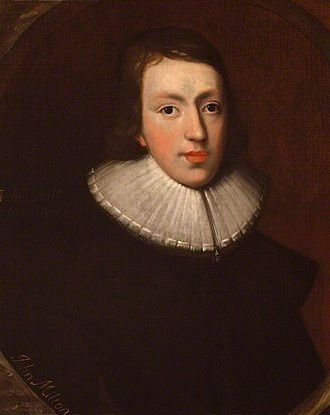
Portrait of John Milton c. 1629
The finding of deceased loved ones in dreams, or imagined on street corners, is neither unusual nor surprising. More especially significant to the grieving, this intensely personal examination of grief is a study of absence as much as presence. Wrought in a furnace of loss, the purity and innocence of the apparition are as vivid to the beholder’s imagination as to deliver him to a state of despair the moment she is fled. And the vision is angelic, a refracted version of the life, as emotionally charged as Rossetti’s pictorial reinvention of Beatrice for a Victorian audience, and as visceral as the brief return of Alcestis in Greek myth.
Pure and utterly unsullied, emblematic, again like Beatrice, of goodness without condition, the dream image is supposedly of Milton’s second wife, Katherine Woodcock , who died in childbirth at the age of twenty nine. The poem was conceived in 1658, some short time after Katherine’s death and it is clear that the visitant exercises an enduring power, sufficient to confound the emotional senses, but extraordinarily moving when distilled with the rhythmical aplomb and syntactical awareness of a master technician.
Milton’s bittersweet rendering of the reality of loss is one characteristic of the greatness of his art: the surety of reunion with the sanctified figure - ‘I trust to have / Full sight of her in Heaven without restraint’ - is compromised in the crushing final lines, where dejection is complete, measured in resonant pauses which can bring no consolation:
But O as to embrace me she inclined
I waked, she fled, and day brought back my night.
‘On His Dead Wife’ is taken from The New Oxford Book of English Verse : 1250-1950 and is published by the Oxford University Press (1972)
Also by Steve Whitaker...
Poem Of The Week: Soirée By Peter Reading (1946-2011)Children's Poem Of The Week: Catamaran Smile By Carmella de KeyserFrom Ukraine To Kilimanjaro: Diana's JourneyPoem Of The Week: Hilltop By Ruth SharmanPoem Of The Week: Pretending Not To Sleep By Ian Hamilton (1938-2001)The shortened address for this article is: newspub.uk/01lfg
Search Results