



search
date/time

Wed, 1:00AM
overcast clouds
16.6°C
WSW 7mph
overcast clouds
16.6°C
WSW 7mph
 | Sunrise | 5:12AM |
| Sunset | 6:56PM |  |
P.ublished 1st September 2026
business
IoD: Business Optimism Rises, But Not Due To Change In Political Leadership
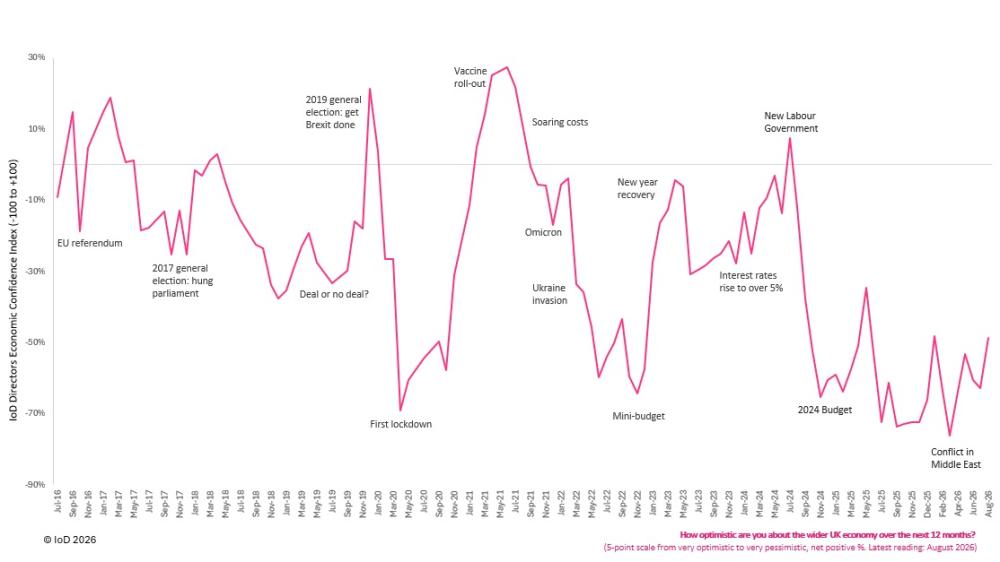
The IoD Directors’ Economic Confidence Index, which measures business leader optimism over prospects for the UK economy, rose to -49 in August, from -63 in July 2026.
Conversely, business leaders became slightly less optimistic about the prospects for their own organisations, with confidence falling to -5, from -2 in July.
Revenue expectations increased to +12 in August, from +9 in July.
Headcount expectations were little changed at -6, from -7.
Investment intentions improved to -9, from -13.
Export expectations remained stable at +4, from +3.
Cost expectations remained elevated and unchanged at +83.
Despite improved level of confidence, the impact of the new Prime Minister and Cabinet on business leaders’ optimism was in negative territory, at -21 for the UK economy and -23 for their own organisations.
When asked about the factors holding back business growth and investment, business leaders overwhelmingly pointed to uncertainty. Tax uncertainty (58%), general policy uncertainty (55%) and demand uncertainty (40%) were the most frequently cited barriers. Weak expected demand (27%) and labour and skills shortages (23%) also featured.
UK economic conditions remain the most significant factor impacting business (selected by 73% of survey respondents, down from 75%)
Concerns about taxation increased sharply, with employment taxes rising to 62% from 54%, and business taxes rising to 56% from 47%.
Compliance with government regulation (40%, up from 35%) and the cost of energy (38%, up from 35%) both overtook global economic conditions (36%, down from 43%) as sources of concern.
The ranking of the leading global risks facing businesses was unchanged from May. A global economic slowdown (57%), geopolitical tensions (54%) and cyber security risks (47%) remained the three most commonly cited concerns.
However, several risks saw notable increases in concern. Citations of misuse of artificial intelligence rose to 36%, from 29% in May, while concern about a global trade war increased to 31%, from 24%. The proportion of respondents concerned about climate change and extreme weather events more than doubled, rising to 17% from 7%.
August saw a welcome improvement in the overall confidence of business leaders in the UK’s economic outlook, with the index reaching its highest level since January, accompanied by improvements in revenue and investment plans. However, this was not driven by a ‘Burnham bounce’. In fact, business leaders said that Andy Burnham and the new Cabinet had on balance reduced their optimism regarding both the UK economy and their own organisations. While some appreciated the change in tone and the devolution agenda, the majority were concerned about unfunded spending commitments and the likelihood of further tax increases, with others staying on the fence until post-Budget. Instead, improved confidence appears to reflect better international growth and business resilience.
As we move into Autumn, businesses continue to be buffeted by domestic policy uncertainty, high costs and elevated global risks. Tax uncertainty and negative impacts from the existing tax system are top of mind for business leaders, accompanied by the outlook for global growth, geopolitics and cyber risk. We have seen a welcome change in tone from the new Prime Minister, but for the government to deliver on its commitment to good growth in every postcode, it must reduce the cost of doing business. To enable businesses to invest and hire, the government must address uncompetitive energy and tax costs and high regulatory burdens, in particular by making improvements to the design of the Employment Rights Act.
Full Results
811 responses from across the UK, conducted between 14-27 August.14% ran large businesses (250+ people), 17% medium (50-249), 22% small (10-49 people), 32% micro (2-9 people) and 13% sole trader and self-employed business entities (0-1 people).
How optimistic are you about both the wider UK economy and also your organisation over the next 12 months?
| Very optimistic | Quite optimistic | Neither optimistic nor pessimistic | Quite pessimistic | Very pessimistic | Don't know | |
| Wider UK economy | 1.2% | 12.2% | 24.0% | 35.4% | 26.9% | 0.2% |
| Your (primary) organisation | 3.3% | 26.9% | 34.5% | 24.5% | 10.2% | 0.5% |
Comparing the next 12 months with the last 12 months, what do you believe the outlook for your organisation will be in terms of:
| Much higher | Somewhat higher | No change | Somewhat lower | Much lower | Donât know | N/A | |
| Business investment | 3.0% | 20.1% | 43.2% | 18.1% | 13.8% | 0.7% | 1.1% |
| Costs | 18.6% | 67.2% | 9.1% | 2.3% | 0.9% | 0.5% | 1.4% |
| Exports | 1.2% | 13.3% | 30.7% | 7.5% | 2.7% | 1.5% | 43.0% |
| Headcount | 1.7% | 19.1% | 49.6% | 20.7% | 6.3% | 0.7% | 1.8% |
| Revenue | 3.6% | 37.5% | 27.5% | 22.3% | 7.0% | 1.0% | 1.1% |
| Wages | 5.2% | 46.1% | 36.5% | 7.6% | 2.1% | 0.7% | 1.7% |
To what extent has Andy Burnham and the new Cabinet affected your level of optimism regarding the UK economy and your primary organisation?
| Feel considerably more optimistic | Feel more optimistic | No change | Feel more pessimistic | Feel considerably more pessimistic | Don't know | |
| UK economy | 3.8% | 19.5% | 31.7% | 22.2% | 22.4% | 0.4% |
| Your primary organisation | 2.6% | 12.1% | 46.1% | 23.4% | 14.1% | 1.7% |
Of the following, which are stopping you from growing/investing in your business? Please select all that apply.
| Tax uncertainty | 58.3% |
| General policy uncertainty | 55.4% |
| Demand uncertainty | 40.0% |
| Weak expected demand | 26.9% |
| Shortage of labour/skills | 22.8% |
| Inadequate return on proposed investment | 16.8% |
| Cost of external finance | 12.9% |
| Other | 12.5% |
| Shortage of internal finance | 10.7% |
| Planning constraints | 10.1% |
| Inability to raise external finance | 9.0% |
| Lack of transport infrastructure | 6.7% |
| Not expecting any limits to capital investment | 2.7% |
| Not sure | 1.7% |
Which of the following, if any, are having a negative impact on your organisation?
| UK economic conditions | 73.2% |
| Employment taxes | 62.3% |
| Business taxes | 56.0% |
| Compliance with government regulation | 39.7% |
| Cost of energy | 38.2% |
| Global economic conditions | 36.3% |
| Skills shortages and/or labour shortages | 28.4% |
| Trading relationship with the EU | 19.0% |
| Difficulty or delays obtaining payment from customers | 15.3% |
| Cost/availability of finance | 15.0% |
| Supply chain disruption | 13.8% |
| Transport cost/speed/reliability | 12.8% |
| Broadband cost/speed/reliability | 9.7% |
| None | 2.7% |
Which of the following global risks are the most concerning for your business? Please choose up to three
| Global economic slowdown | 56.8% |
| Geopolitical tensions | 54.1% |
| Cyber security risks | 46.9% |
| Misuse of artificial intelligence | 36.4% |
| Global trade war | 30.7% |
| Climate change, including extreme weather events | 17.0% |
| Global health risks | 6.4% |
| None | 5.4% |
| Don't know | 0.6% |
The shortened address for this article is: newspub.uk/020ry
Search Results