



search
date/time

Thu, 10:00PM
clear sky
26.0°C
E 7mph
clear sky
26.0°C
E 7mph
 | Sunrise | 3:44AM |
| Sunset | 8:34PM |  |
P.ublished 9th July 2026
frontpage
Girls Allowed! St Peter’s Celebrates 50 Years Of Co-Education
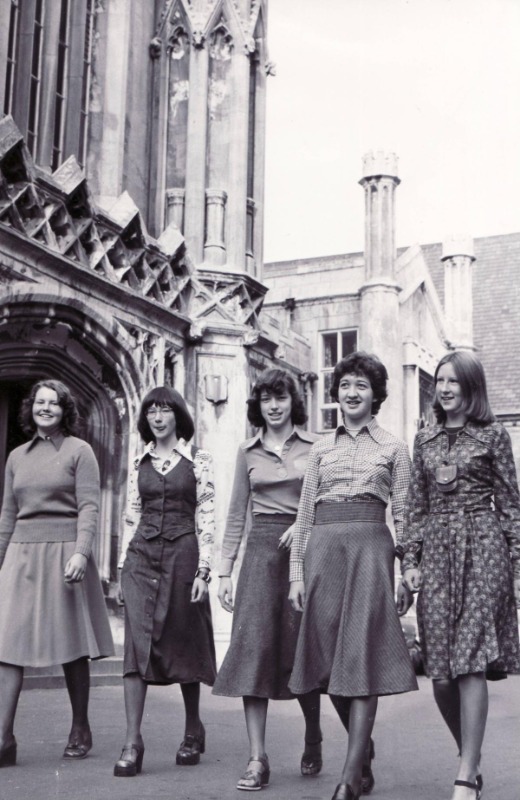
St Peter's first girls 1976 (l-r) Louise Stansfield, Zoe Jackson, Nicky Jesper, Louise Adams and Sue Elston
It was a truly historic occasion for St Peter’s, founded in AD 627, fully 1,350 years before five brave and ground-breaking girls walked through its doors as sixth-form students.
The girls, Louise Stansfield, Zoe Jackson, Nicky Jesper, Louise Adams and Sue Elston remain in touch today and are proud of the significant role they have played in the illustrious history of the school.
This milestone marked the beginning of co-education at St Peter’s, which became fully co-educational by 1987, had its first female head prefect in 1989 and is now equally divided between boys and girls.
50 years on, there are now equal opportunities for boys and girls in academics, sport, music and other cocurricular for boys and girls, with the school’s focus firmly the school's focus on diversity, equity and inclusion.

Jeremy Walker,
“I was delighted to be able to co-host an on-line question and answer session with all five girls in 2021 and hear what they felt about being the first girls at St Peter’s, what their experiences had been at school and how their time here had influenced their future life choices. Their positive answers confirmed that the school’s decision to go co-ed in 1976 was the correct one.
He added: “It is quite astonishing to look back and consider that these five girls were the ones who opened the doors for all those generations of girls and women who followed. There is now a great sense of legacy and history of girls being at St Peter’s.”
Louise Adams, now Louise Morales, an artist and interior designer living in Paris, recalls: “The experience of being one of the first girls at St Peter’s was exciting, daunting and a real privilege. We were special. We were stars. I remember feeling a lot of tension and embarrassment from being in the limelight, but at the same time pleasure.
“There were lots of parties and socialising and we all made friends with the boys. Indeed, Sue and Louise actually married their boyfriends from school. Would I do it all again in hindsight? Yes.”
She added: “St Peter’s has a sense of history that is so wonderful and we were so privileged to be able to study there. The school gives you the foundation for a fulfilling life."
The co-host of the old girls on-line Q&A session was Victoria Inness, the first Head Girl at St Peter’s from 1989-1990 and the first female President of the Old Peterite Club. She arrived at St Peter’s in the Sixth Form from York College for Girls.

Victoria Inness
“I needn’t have worried. To my astonishment and joy, I was told I was going to be the first head girl in the history of the school. I was incredibly proud and, being honest, I still am today.”
“Looking back at the original decision to admit girls to the Sixth Form 12 years before I arrived at St Peter’s, it was incredibly brave. Change on this scale, in an institution this old, is never simple.
“And those first five girls required resilience— simply to show up. To sit in rooms where you felt your presence was a novelty. To walk into chapel, through the monkey cage, into lunch and feel conspicuous. To prove, day after day, not that you were special, but that you were simply normal. Simply a pupil, like everyone else. Some might define it as endurance.”
“I imagine it required humility too — a willingness to accept that things were not perfect. To earn trust slowly. To let friendship grow in its own time. The first girls may have arrived with fanfare, they describe feeling like superstars. But they also arrived with quiet determination, and they changed our school for ever.”
By 1986-87, the school had seen enough to know that this was the right path. Girls were welcomed throughout, in every year group. Co-education was no longer a concession.
“When I look back, what I understood very quickly was that I was not representing just myself. I was representing every girl who had arrived before me, and every girl who would come after. That is a weight, but it gives you something to stand for that is bigger than yourself. Ultimately though, despite the apparent significance for others, I was focussed on being not the first Head Girl but simply the best Head of School that I could be.”
She concluded: “What our school gave me and what I hope it gives everyone who passes through it is far more than exam grades. It gave me opportunities that I wouldn’t otherwise have had and a framework for how to be in the world. We, girls and boys, left school ready to take on anything and there is no doubt that as young women we were prepared for a male-dominated work world.”
This framework is reflected and underlined in St Peter’s School Charter, which features four guiding principles: Challenge, community, equity and kindness, with seven key values: Friendship, trust, wisdom, compassion, endurance, humility and hope. There’s no doubt that the arrival of girls at St Peter’s, half a century ago, paved the way for this seminal Charter – and for the success of the school today.