



search
date/time

Sat, 1:00PM
broken clouds
11.4°C
NNE 13mph
broken clouds
11.4°C
NNE 13mph
 | Sunrise | 6:35AM |
| Sunset | 5:03PM |  |

Steve Whitaker
Features Writer
@stevewhitaker1.bsky.social
P.ublished 11th August 2026
arts
Citizens Of Nowhere: Journeys Of Hope - The Letters Of Meyer And Sonia By Alison Marshall
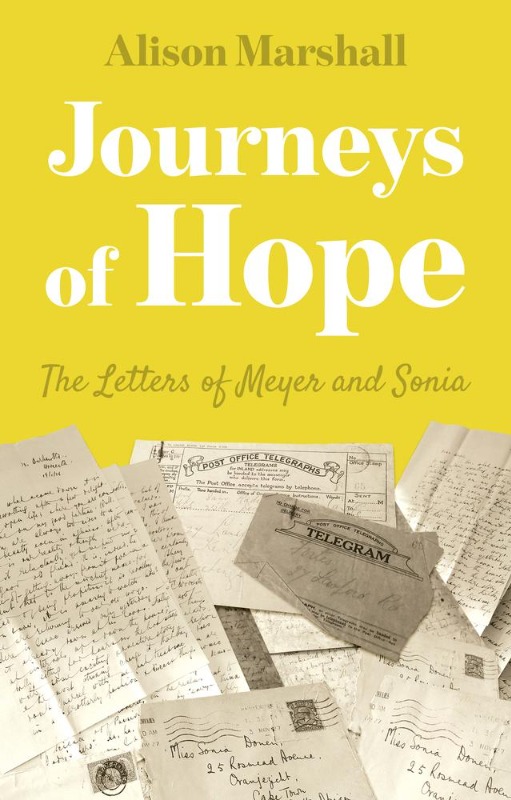
Marshall’s tone – she is an eloquent commentator – is never compromised by a surfeit of sentiment: she recognises the necessity of detachment and assiduous research in the effective promulgation of what is, by any measure, a labour of love. Not least in the opening chapters of Journeys of Hope where she gives narrative context to her family’s Ashkenazi, and probably Sephardi, antecedence with a long, and thorough, description of the Russian Jewish Pale of Settlement, from which Meyer Fortes’ family became emigres; and of cruelty, pogrom and cataclysmic cultural shifts under the aegis, at first, of the Czars and then of the Bolsheviks. Marshall is a fine historian; her detailing of the salient moments in her ancestors’ experience is by turns harrowing and tectonic: conceived in broad brush-strokes, her overview necessarily incorporates a whole region’s diasporic upheavals within its compass, giving a de facto voice to the countless thousands of other displaced and disappeared figures whose own historical mark has been erased.
Here is another mark, this time of narratorial integrity, fixing the personal in the macrocosm of great social and political crisis. And at the centre of the vortex, a young couple, Sonia and Meyer, making a faltering, but confident, passage across continents to locate a sense of home and purpose in a shifting landscape of sporadic antisemitism. Marshall’s early foray into the cultural history of the Shtetls of the Eastern margins of Europe is both illuminating and instructive: her own visit to the former Jewish settlements of the Baltic states in 2017 yields little about those who departed Latvia and Lithuania a generation prior to the Holocaust, to focus, not unreasonably, on the apocalypse of the latter. Sonia left the region for South Africa long before the rise of Nazism and neither she nor her family were caught up in its maelstrom. But the documentary elision speaks at least as much about prioritisation as inclusive commemoration, a distinction that would no doubt have appealed to the young Meyer, who later went on to become a renowned social anthropologist, working with, among others, Bronislaw Malinowski, and is in no way intended to occlude the memory of those who strove, between the wars, for a greater sense of fulfilment. Marshall, herself a not inconsiderable sociologist, identifies a degree of pragmatism in the long journey of her grandparents:
‘Sonia and Meyer took a different route, surviving by adapting, by assimilating, rather than by studiously preserving the culture of their ancestors. It was not an easier route, but a different one.’
Maybe the process of assimilation, the ability to adapt to circumstance and context, is a necessary gift of the ‘citizen of nowhere’. Later in this, by turns, illuminating and philosophical enquiry, we hear the retrospective testimony of a witness to Meyer’s pre-war ethnographical research in 1930s Ghana, which perfectly corroborates the young man’s insight and natural proclivity for acculturation. Speaking of Meyer’s time with the Tallensi people in West Africa, Moses Anafu describes the former’s gift:
‘They knew his name was Dr. Fortes; but for them, however, he was, and remained to the end, Solmiin Taleng: “the white Tallensi”. In part, the appellation was in recognition of his knowledge of their culture and language, arguably one of the most difficult African languages to master. More importantly, however, it signified that for the Tallensi, Meyer Fortes was one of them.'
But it is to the letters between the two that Marshall, and her book’s audience, are most indebted since it is Sonia and Meyer’s words that give focus to a time in almost constant flux: if we are impressed by the observer’s insinuation of a historical and geopolitical narrative, then it is her grandparents who open a window on the panorama, with dramas of emotional longing, of discovery and optimism alongside the necessary corrective of practical common sense. The early chapters of Journeys of Hope, describing Meyer’s odyssey to Britain via the island of Madeira, and his initial immersion in his new home, is a paean to hope; ever cheerful if trepidatious, Meyer’s letters to Sonia Donen in Cape Town are thoughtful and considerate, yet tempered by an inner surety, a sense of competence and rectitude that is improved upon by the circle of acquaintances he develops from the start. Facilitated by his former academic mentor, Lancelot Hogben, Meyer falls, with joyful proactive endeavour, into the social milieu of both Sylvia Pankhurst and Harold Laski, amongst several other luminaries, some of whom will aid his later vocational trajectory.
If Sonia’s replies are less incautious and more anxious as to joining Meyer in the ‘smoke’ that he describes with vivid revulsion – Meyer prosecutes his studies at the British Museum in contented isolation – she has solid practical reasons for providing a corrective to Meyer’s infectious hubris. Concerned as to how the couple might survive in the straitened circumstances of a world fast approaching the nemesis of the Great Depression, her early letters suggest a mind given to justifiable procrastination. Yet her tone is directly counterpointed by that of her fiance, whose wit and deliciously irrepressible yearning is, itself, contradicted by the image of the genteel professor who Marshall later remembers on her childhood visits to Cambridge. In a letter to Sonia, he writes:
‘Think of the relief of being able to talk straight out to you & not having to sit thro’ two midnights or more vainly endeavouring to squeeze the thought (and) feeling of an aeon into a dozen pages of words. Besides I’ll be able to go to bed early’
Sonia and Meyer’s stories are by no means the only threads that unite Marshall’s wide-ranging narrative. Surrounding her central protagonists’ endeavours like atoms in a nucleus are other stories of success and, sometimes, blighted hope; Marshall’s camera-eye roves over terrains as disparate as the Leyland slums of fin de siècle Leeds, peripatetic travels across Russia to avoid persecution, and the unlikely destination of Memphis, Tennessee, where Meyer’s sister Annie and her husband Aaron, ensconced in South Africa, seem destined to circle each other from afar.
But at least as pertinent are Alison Marshall’s ruminations on her personal relationship with the idea of being a ‘citizen of nowhere’, her lack of an existential sense of belonging. Her own replication of the diasporic journeys of her ancestors culminates in a lengthy visit, during the Covid pandemic, to Ukraine. The story she retails of that time is of taking stock, a dissection of the history of the region and a detailed, and moving, account of hardship and endurance that begins to adopt a patina of prescience given the following invasion, and continuation of a plan of Russian domination that began in 2014. And perhaps this is the greatest strength of Marshall’s analysis: her acute, necessarily intuitive, awareness of the great arc of history, and its tragic capacity for relentless repetition.
A history drawing us to the self-imposed tyranny of Brexit, that now casts a shadow over the UK, and over Marshall’s narrative. Her deliberate inclusion of a movement almost exclusively predicated on the ruthless controlling of immigration is profoundly fitting: the proponents of Brexit represent a collective embodiment of the kinds of xenophobia that fuelled the British Union of Fascists and its scapegoating of the Jews, in the period that followed close upon the arrival of Meyer, and later Sonia, in London.
More information here.
Also by Steve Whitaker...
Poem Of The Week: Facing The Music By Mairéad ByrneVenus At Midnight: The Amygdala Safari By Carmella de KeyserReview: Peas On Your Knees - A Life In The Poems Of Michael RosenPoem Of The Week: From Cheshire By Kit WrightPoem Of The Week: Among The Talk And The Laughter By Norman MacCaig (1910-1996)The shortened address for this article is: newspub.uk/020gr