



search
date/time

Sat, 1:00PM
overcast clouds
16.9°C
WSW 7mph
overcast clouds
16.9°C
WSW 7mph
 | Sunrise | 4:26AM |
| Sunset | 7:36PM |  |

Andrew Liddle
Guest Writer
P.ublished 2nd May 2026
arts
A Century Of The Thistle: Hugh Macdiarmid And Scotland’s Modernist Voice
Dr. Andrew Liddle considers why a major literary anniversary is passing unnoticed
.jpg)
A Drunk Man Looks At The Thistle Kindle Edition
by Hugh MacDiarmid OTB eBook publishing
Amazon Kindle
Born in Langholm, in 1892, as Christopher Murray Grieve, MacDiarmid was the son of a postman and intellectually precocious from an early age. Long hours in the local library and a self-directed study in literature and philosophy laid the foundation for a literary career that would blend poetic innovation with political engagement. He trained as a teacher in Edinburgh and worked for local newspapers before enlisting in the Royal Army Medical Corps in 1915. War service in the Balkans and France exposed him to the wider world and shaped the ambitious literary and cultural vision that would define his work.
Central to MacDiarmid’s ambition was the revival of ‘Scots’, as he called it, as a literary language. He sought to assert Scotland’s artistic independence while reinvigorating a literature he felt had grown sentimental. His advocacy of ‘Scots’ became a cornerstone of the Scottish Renaissance, influencing poets such as Robert Garioch and Norman MacCaig, as well as designers, painters, and broader cultural figures of the period. In his early collections and through the series Northern Numbers, which he edited, MacDiarmid blended Lowland dialects into a unified literary language, a ‘synthetic Scots’ that could convey philosophical depth and modernist experimentation.
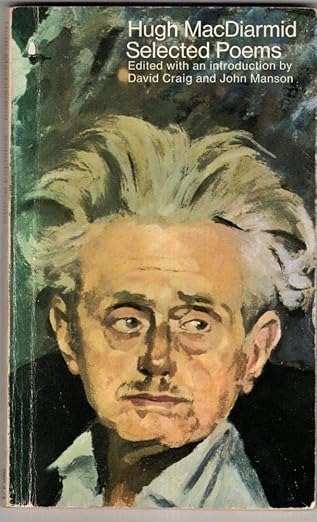
Hugh MacDiarmid - Selected Poems Paperback –
by Hugh MacDiarmid (Author), David Craig (Editor), John Manson (Editor). Publisher Penguin
A Drunk Man Looks at the Thistle in so many ways shows conflicts of interests and illustrates the difficulties, if not impossibilities, of being a poet of the people without dividing parts of the nation. The poem fuses free verse, stream-of-consciousness, internal rhyme, and discursive meditation, creating a rhythm that mirrors MacDiarmid’s reflections on Scotland’s cultural, industrial, and moral landscape. The thistle, resilient yet prickly, becomes a symbol of the nation and of intellectual endeavour. In blending philosophical speculation, political reflection, and lyrical inventiveness, MacDiarmid demonstrated that Scots could sustain modernist ambition while remaining deeply rooted in vernacular tradition.
This very innovation, however, contributes to the curious paradox: a poem written a century ago can feel more challenging to read and enjoy than one composed over two centuries earlier. Burns’s poems, most of them written for publication in 1786, flow with warmth, humour and musicality, the qualities that have kept them alive in everyday recitation and memory. My grandfather, a working man, could quote the whole of Tam O’Shanter, all 200-odd lines, by heart - and frequently did in a voice quivering with emotion.
MacDiarmid’s synthesis, in contrast, combines dialects, archaisms, and neologisms with philosophical and political abstraction, demanding sustained attention and reflection. In a word, it’s hard work reading it. Its density can feel daunting, yet this difficulty is intentional: the work asks readers to grapple with Scotland’s history, culture, and identity, transforming reading into a more active, contemplative engagement. In this sense, accessibility is not the measure of value; the challenge itself is part of the literary and intellectual reward. He consistently challenges readers to grasp the thistle, so to say.
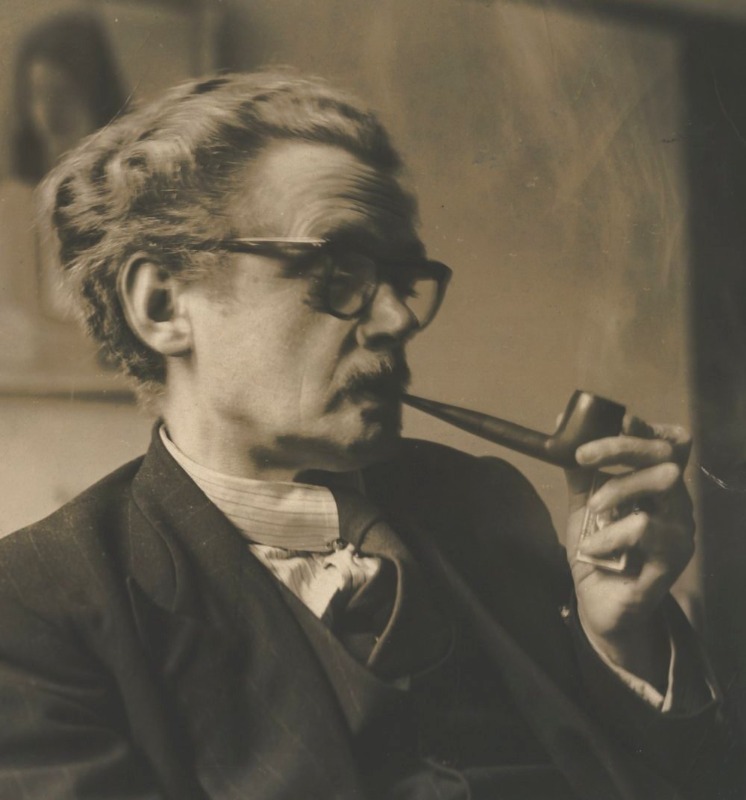
Hugh MacDiarmid.
Image provided by Carcanet Press.
The historical context of MacDiarmid’s work is central to understanding its significance. Writing in the interwar period, amid industrial decline, political unrest, and social upheaval, he confronted a Scotland in transformation. The erosion of traditional life and the stagnation he perceived in contemporary culture fueled his vision for a revitalized national literature. At the same time, MacDiarmid’s engagement with European modernism - the gloomy elitism of T. S. Eliot, the multilingual experimentations of Ezra Pound and the modernist lyricism of Yeats - positioned Scotland within a broader literary conversation, demonstrating that Scottish writing could participate in global intellectual currents without abandoning its distinctive linguistic and cultural identity. Edinburgh might no longer make claim to be the ‘Athens of the North’, as it had in Adam Smith’s day, but it was still intellectually and culturally relevant.
Critically, reception of MacDiarmid has been complex. Scholars debate whether his synthetic Scots can feel artificial, and whether his philosophical and political ambitions sometimes overshadow the poetic. Yet his discursive, idea-driven approach challenges readers to engage with Scotland’s cultural and moral identity in ways traditional lyric poetry rarely does. The debate itself underscores the ambition and breadth of his project: MacDiarmid was never content with small-scale lyricism. Rather, he sought to make poetry a vehicle for national self-examination, intellectual inquiry, and cultural renewal.
In 2026, the centenary year of publication, A Drunk Man Looks at the Thistle offers an opportunity to reflect not only on MacDiarmid’s achievement but also on the enduring tensions in Scottish literary culture between accessibility and ambition, tradition and modernism, vernacular familiarity and intellectual challenge.
That a poem written a hundred years ago might present more difficulties than one composed much earlier does provide food for thought about a whole range of issues, including the very purpose of poetry. Burns wrote for immediate enjoyment and communal experience; MacDiarmid aimed to provoke thought, to question, to engage reader and nation in dialogue with themselves and the wider world. Both approaches are legitimate, of course, but MacDiarmid’s work exists to remind us that literature can demand, challenge, and reward readers in ways that transcend ease and immediacy - whereas Burns voiced universal truths in simple, unadorned Scottish dialect, which paradoxically could be understood by the whole of the English-speaking world and touched the heart.
Ultimately, the centenary of MacDiarmid’s masterpiece is a reminder of the resilience and richness of Scotland’s literary tradition. His blending of dialects, history, philosophy, and his political engagement created a language capable of both intellectual depth and cultural pride. While ordinary readers may approach his work cautiously, scholars and poets alike continue to find inspiration in its audacity. In bridging past and present, vernacular and philosophical, lyric and argument, MacDiarmid ensured that Scottish literature remains both rooted and ever-reaching - a testament to the enduring power of language, imagination, and cultural identity.
So far, alas, I have seen nothing to herald the anniversary of the centenary which might be celebrated best, perhaps, in November, the month of publication, in 1926.
Whilst I admire MacDiarmid, for me, however, a single line by Burns is the greatest assertion of the democratic spirit, understated and not prickly and bethistled but utterly devastating:
‘A man’s a man for a’ that!’