


search
date/time

Sat, 1:00AM
clear sky
8.0°C
WNW 16mph
clear sky
8.0°C
WNW 16mph
 | Sunrise | 6:48AM |
| Sunset | 4:48PM |  |

Steve Whitaker
Features Writer
@stevewhitaker1.bsky.social
P.ublished 6th May 2018
arts
Remembering England: Peter Bland And Rennie Parker

Yorkshire-born poets Rennie Parker and Peter Bland share no stylistic or tonal kinship, but they are united in the fact of a willed removal from the circumstances of their respective lives: Parker, by imagining the past as though it were being lived in the present, and Bland, by embracing the sometimes seductive austerities of the postwar urban Britain of his youth, from the perspective of a long exile in New Zealand.
The past, for Rennie Parker, is a place of meaningful, often ancient, ritual whose importance to her wandering rural journeys resides in their power to illuminate the present. Time’s continuum is illustrated in shifting signifiers which move as randomly between the centuries as that other poet of totemic histories, Jeffrey Wainwright. The wind-blown 'overtones' of the poem ‘First and Second Entrance’ skew a sense of fixed historical perspective as they move brushwood about a derelict country chapel, the 'art' of nature exercising its boundlessness suo tempore. Past and present run concurrent here too: the mediaeval rapacity of land-grabbing and summary punishment – the brutal image of a 'Grand Inquisitor / in all his twisted metal' figures for the enforced piety of a bygone era – is ironically reflected in the present church’s gate 'laced with warnings of Rural Theft'
‘Bastard England’ is bastardised in both senses, its thin comforts given neat expression in the anachronistic and sinister window of a shop whose survival seems as unlikely as its ancient till, 'a till stuck' – significantly –'on ‘No Sale’ (‘In fear of regional woolshops’). Parker has an acute eye for the 'viscid sickness' of decline: the 'chalk-white' assistant, whose features appear 'stitched on', is as creepily inanimate as the 'lopsided' mannequins which ‘people’ the shop front.
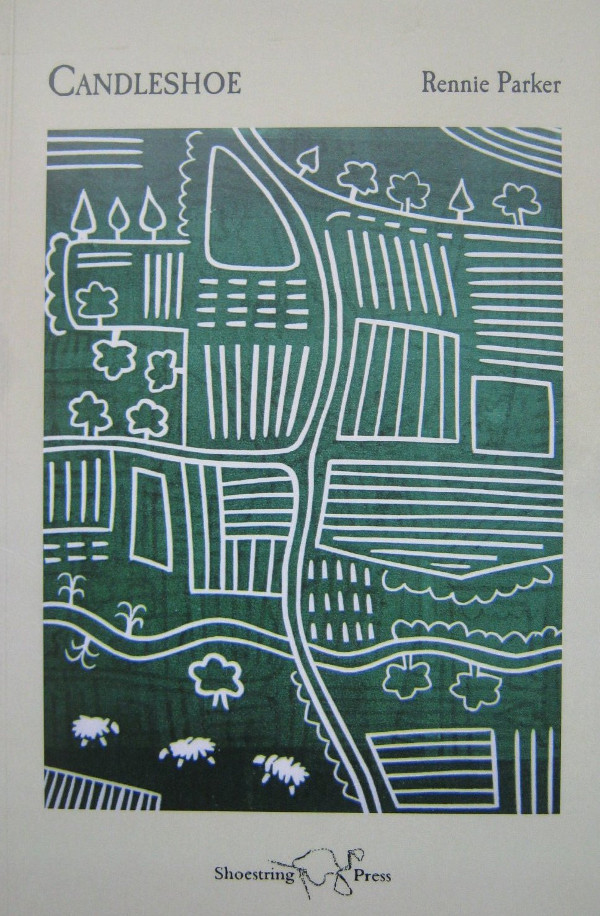
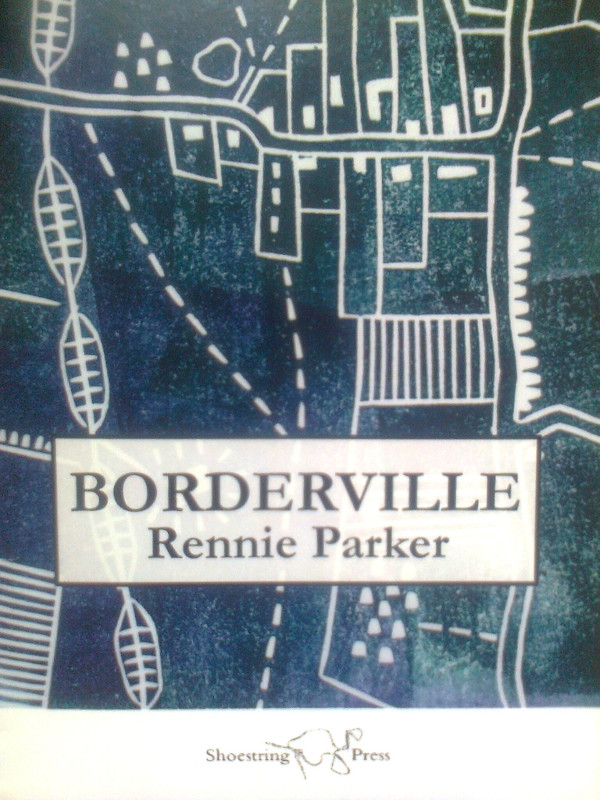
Candleshoe was Parker’s second verse collection and the inclusion, here, of the central cluster of poems of her earlier volume, Borderville, would suggest the self-conscious development of a voice. But there are few fixed markers in evidence within her sustained regional engagement. That her vision refuses, like an eye in REM sleep, to still where it alights, generally adds to the effect of weightlessness. She won’t hold focus and flits over landscape at the speed of her own sonority; her sense of rhythm nourishing the ground she briefly rests on.
The presence of the figure of a ‘Fool’ in several poems is liminal like the personified rain: a figure who at one level directs philosophical traffic like a Deus ex Machina, and at another, is subsumed into the narrator’s landscape. Where rain is given body, the Fool is denied it; re-gendered as Gaia-mother, she is the burden of history whose imprint blunts the soil or who acts as a warning: 'And Fool seen striding across fen dykes / Larger, more dangerous than before' (‘The difficult surface of Lincolnshire’).
We have the distances of geography and time to thank for the clarity of Peter Bland’s collection, Remembering England. Scarborough born but Kiwi by inclination, the fact of Bland’s exile enables a concentrated rear-view - a vision uncontaminated by closeness. Another Yorkshireman and occasional exile, Tony Harrison, wrote simply and movingly of life in post-war Leeds from the culturally remote standpoints of Florida and New York, and it is difficult not to infer a connection between his Sonnets for 1945 sequence, and Bland’s ruminations on the industrial North of that period. Bland’s ‘Lament for a Lost Generation’ describes a threadbare but happy austerity shadowed by a failure of hope:
'Between V-J Day and 1951
we wore our first grey longs.
Drab, insular, short of vitamin C,
Much given to fags and the fumbled grope'.
The consonantally-vital arc of the commemorative impulse is also Harrison’s; the ‘fumbled’ present, a precursor of an uncertain future, 'a lasting doubt / about the next good time'. Bland bangs an elegiac drum to secure memory, and excepting where he lapses into an unexpected surreality, his poetry is direct and object-laden, as if the furniture of the past provided the comfort of identity.
Also by Steve Whitaker...
Poem Of The Week: Facing The Music By Mairéad ByrneVenus At Midnight: The Amygdala Safari By Carmella de KeyserReview: Peas On Your Knees - A Life In The Poems Of Michael RosenPoem Of The Week: From Cheshire By Kit WrightPoem Of The Week: Among The Talk And The Laughter By Norman MacCaig (1910-1996)Bland affords a good, solid introduction to poetry for the newcomer. Mercifully free of arcane abstraction, his balladry for a lost time bears the integrity of honesty. These are poems of great warmth and vigour which open an authentic vista on an England now vanished.
Candleshoe and Remembering England are both published by Shoestring Press.
The shortened address for this article is: newspub.uk/0fqp